Year Four (D4)

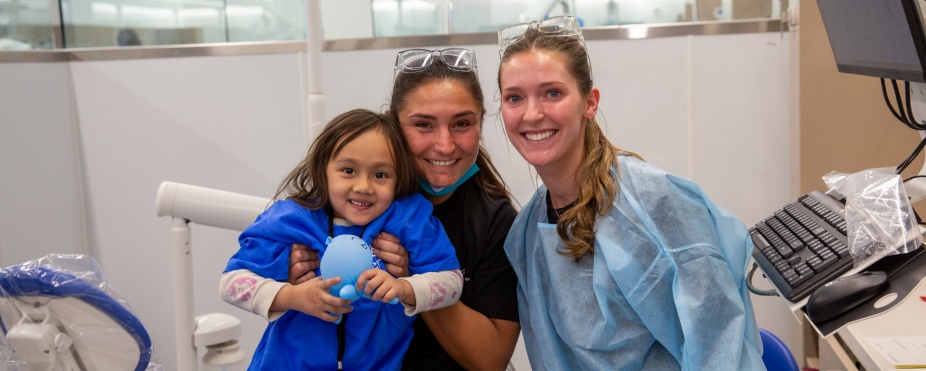
The fourth-year concentration program allows students to pursue their career interests in dentistry or to begin to focus on a specialty area that may or may not be pursued after graduation. Fourth-year students can select courses from a wide range of clinical, basic, and behavioral sciences, based on their individual interests.
On This Page
D4 Highlights
D4 students spend a lot of time in the clinic. The fourth year also consists of externships and remote area medical clinical service trips. Students will also have the opportunity to pursue concentrations during the fourth year, as well as taking elective courses. The year concludes with students applying to residency, taking their regional state licensing exams, and finally, graduation!
Clinic Experience
In the fourth year, the time devoted to clinical patient care is expanded. Fourth-year students spend five full days in the clinic each week, with classes and labs scheduled before clinic at 7:30 or 8:00 a.m. or after clinic at 4:00 p.m. Students remain in the operatories assigned for their use at the end of the second year. Fourth-year students provide all phases of dental care to between twenty-two and twenty-six patients. At this level, students take on the major responsibility for determining and meeting their patients’ treatment needs, and learn to examine, diagnose, and develop treatment plans; they also schedule care for their patients in an efficient and productive manner. The objective of this fourth-year clinical experience is to simulate private practice and facilitate the transition to the responsibilities of a licensed practitioner.
Off-Campus Clinical Experience
Continued rotations through local hospital dental clinics provide additional clinical experience. In the fourth year, the hospital experience is broadened and students have the opportunity to participate in rounds and clinical conferences.
Year 4 Curriculum
Click the expanders below to view full course descriptions.
Fall Semester
Students will learn how to manage a diverse patient population and have the interpersonal and communication skills to function in a multicultural work environment. This courses discusses in-depth the factors and practices that are associated with disparities in health and health care.
Comprehensive care is defined as the diagnosis, prevention and treatment needed to restore optimal oral health, function and appearance. The School’s pre-doctoral students manage their patients comprehensively. This includes referral of their patients to the School’s advanced education programs when indicated, while always maintaining oversight of the patient’s overall care.
The course will be based on team-based learning. The purpose of the course is to facilitate student learning through group activities focusing on evidence based literature, observing D4 case presentations and participating in class discussion. D3 students are divided into presentation groups. Each group will present an evidence-based published article one time during the semester.
This case-based course involves group presentations that allow students to apply information obtained in other courses to a simulated clinical situation. The focus of the presentations is on development of management strategies based on specific medical and oral health circumstances.
Orthodontic Clinic I provides students with an introduction to the clinical assessment and management of patients requiring orthodontic care. Under close faculty supervision, students apply foundational orthodontic principles to patient evaluation, diagnosis, and preliminary treatment planning within a comprehensive care model.
Emphasis is placed on clinical examination, growth and development assessment, occlusal analysis, and interpretation of diagnostic records, including radiographs, photographs, and study models. Students gain experience in identifying malocclusions, assessing skeletal and dental relationships, and determining appropriate timing for orthodontic intervention or referral.
The Oral & Maxillofacial Surgery Clinic provides students with supervised clinical experience in the evaluation and surgical management of patients requiring dentoalveolar and related surgical care. Emphasis is placed on comprehensive assessment, diagnosis, treatment planning, and delivery of safe and effective surgical procedures within a general dental practice setting.
This preceptorship program is designed to provide an immersive pediatric dentistry experience. Each student is assigned a block of 10 consecutive days. The 10-day block time is posted on the Intranet and an individualized schedule outlining the daily rotation assignment is posted on UB Learns. The rotation is comprised of internal and external UBSDM clinic sites, along with an assigned outreach event.
Students will learn to perform endodontics screening, formulate an endodontics diagnosis, perform successful pulpal anesthesia, perform non-surgical root canal therapy, and self-assess treatment outcomes. This course is part of the combined third and fourth year integrated clinical program, specifically addressing the endodontic needs of the patients of the School of Dental Medicine.
This course provides an introduction to the principles, safety considerations, and clinical applications of laser technology in contemporary dental practice. Students develop foundational knowledge of laser physics, tissue interaction, wavelength selection, and the biologic effects of laser energy on hard and soft tissues.
This clinical course is designed to increase your knowledge and improve your technical expertise in the delivery of periodontal therapy and its role in maintaining oral health.
This course will help prepare the soon to be graduating clinician with the next phase of their career by teaching them about oral healthcare models and provide them with an understanding of what is needed to successfully treat patients in a dental practice and ultimately purchase or establish a private practice. The course will include participating faculty who bring professional practice experience and knowledge to help prepare students for their transition to new dentists.
Indirect Restorations III is an advanced clinical course focused on the comprehensive planning and delivery of complex indirect restorative treatment. Building upon foundational and intermediate fixed prosthodontic principles, students refine their diagnostic, technical, and clinical skills in the restoration of single teeth and short-span edentulous spaces using contemporary materials and techniques.
Operative Dentistry is the art and science of Dentistry which deals with the prevention and diagnosis of caries, its management based on risk assessment, the restoration of individual teeth to proper occlusal function and to a form which is in harmony with surrounding hard and soft tissues.
This 4th year patient-centered clinical experience in Operative Dentistry puts into practice what was learned in the 2nd year Operative Preclinical course series (RDN809/810), 3rd year Operative didactic course (RDN835), clinical experiences in D3 year, and serves as the foundation for comprehensive patient treatment in the 4th year.
This course is part of the combined third- and fourth-year integrated clinical program. The overall goals, objectives and methods of evaluation are consistent with those of third-year Comprehensive Care Clinic courses CLD841-842.
This clinical course series provides basic clinical experience in the replacement of missing teeth with dental implants utilizing appropriate diagnostic procedures and evidence based dentistry to determine appropriate treatment options.
Spring Semester
Comprehensive care is defined as the diagnosis, prevention and treatment needed to restore optimal oral health, function and appearance. The School’s pre-doctoral students manage their patients comprehensively. This includes referral of their patients to the School’s advanced education programs when indicated, while always maintaining oversight of the patient’s overall care.
The course will be based on team-based learning. The purpose of the course is to facilitate student learning through group activities focusing on evidence based literature, observing D4 case presentations and participating in class discussion. D3 students are divided into presentation groups. Each group will present an evidence-based published article one time during the academic year in either the Fall or Spring semester.
Dental Clinical Diagnosis III is an advanced course focused on the comprehensive evaluation, diagnosis, and treatment planning of patients with complex oral health conditions. Building upon foundational diagnostic principles, students integrate clinical findings, radiographic interpretation, medical histories, and risk assessments to develop evidence-based, patient-centered treatment plans.
Dental Orthodontic Clinic II builds upon foundational clinical orthodontic experiences and emphasizes the continued management of patients undergoing active orthodontic treatment. Under faculty supervision, students expand their skills in diagnosis, treatment planning, appliance therapy, and longitudinal case management within a comprehensive care model.
The students will function in the various clinical environments with responsibilities including performance of patient assessment and dentoalveolar surgery, assisting/observation of complex dentoalveolar surgery and observation of conscious sedation administration.
Pediatric Dent Clinic 4 (Spring): Students will be introduced to new concepts, while reinforcing the basics in the distinctive aspects of pediatric care in the dental environment. Further exposure to the physical, cognitive, emotional and social aspects of the pediatric population coupled with the epidemiology of oral disease at that age will be explored. Students will acquire a deeper understanding of the fundamentals of the developing dentition, as well as gain exposure to varying pathologies, syndromes and anomalies that may occur in this population.
Skills in the methods of basic and advanced behavior guidance will be further developed. Students will have the opportunity to participate in the care of a patient while under general anesthesia and shadow a PGY1 resident during after-hours call at John R. Oishei Children’s Hospital. Students will continue to gain an understanding of the relationships within the treatment triangle and the importance of child advocacy.
The purpose of this course is to build on the foundational principles of behavioral medicine as it pertains to clinical practice. Students will learn the importance of integrating dental and behavioral components to optimize patient care. Students will also become skilled in applying the principles and processes of behavioral medicine. This biopsychosocial approach to care will enrich provider and patient satisfaction, as well as enhance treatment outcomes. A behavioral medicine orientation will also offer the student insight as to how their own behavior affects patients and the quality of their care. This course will contribute to competence in practice, developing expertise in behavioral medicine as a complement to dental proficiency.
This course is part of the combined third and fourth year integrated clinical program, specifically addressing the endodontic needs of the patients of the School of Dental Medicine.
Periodontology Clinic II is an advanced clinical course focused on the comprehensive management of patients with periodontal diseases and peri-implant conditions. Building upon foundational periodontal therapy principles, students refine their diagnostic, therapeutic, and maintenance skills in the treatment of mild to moderate periodontal disease within a comprehensive care framework.
Indirect Restorations Clinic IV is an advanced, competency-based clinical course emphasizing the comprehensive management of complex fixed prosthodontic cases. Building upon prior clinical experiences, students demonstrate increasing independence in diagnosis, treatment planning, execution, and long-term evaluation of indirect restorative procedures within a comprehensive care model.
Direct Restorations Clinic IV is an advanced, competency-based clinical course focused on the comprehensive management of patients requiring complex direct restorative procedures. Building upon foundational and intermediate clinical experiences, students demonstrate increased independence and refined technical proficiency in the restoration of teeth affected by caries, trauma, wear, and developmental defects.
Implant Dentistry Clinic III is an advanced clinical course designed to provide students with supervised experience in the restoration and maintenance of dental implants within a comprehensive care framework. Building upon foundational knowledge of implant biology and treatment planning, students refine their skills in case selection, interdisciplinary coordination, and delivery of implant-supported prostheses.
Removable Prosthodontics Clinic IV is an advanced, competency-based clinical course focused on the comprehensive management of patients requiring removable partial and complete denture therapy. Building upon prior preclinical and clinical experiences, students demonstrate increasing independence in diagnosis, treatment planning, fabrication, delivery, and post-insertion care of removable prostheses.
Concentration Program
The concentration program is an option that allows fourth-year students to focus their course selections and gain additional clinical experience in specific areas of individual interest. Current concentrations include endodontics, esthetic dentistry, oral biology, oral diagnostic sciences, pediatric dentistry, periodontics, and prosthodontics.
Students admitted to one of these concentrations take a set program of clinical and didactic courses and work more closely with the faculty of a particular department. Interested students apply to participating departments at the end of the third year.
4th Year Pictures
View pictures of DDS fourth year life below:
Phone: 716-829-6925
Fax: 716-829-2731
Email: sdmadmit@buffalo.edu
Hours: 8:30 a.m.-5 p.m., M-F
DDS Admissions
School of Dental Medicine
315 Squire Hall
University at Buffalo
Buffalo, NY 14214