
PhD & Postdoctoral Training Goals

The primary mission of the PhD and Postdoctoral Training Program in Oral Biology is to prepare individuals for careers in research and education in academia or industry, and to become leaders in oral health research.
Goals
Graduates will have the qualifications and research expertise to become global leaders as scientists in academia or industry.
Goal 1: Gain appropriate depth and breadth of knowledge in oral biology and biomedical sciences.
- Successfully complete a core curriculum that provides a fundamental understanding of biological processes in behavioral, biomedical, and clinical aspects of oral health.
- Successfully complete the Preliminary Examination (PhD trainees).
Goal 2: Become exposed to interdisciplinary scholarship and research.
- Attend and actively participate in the department's seminar series as well as other seminars within the biomedical campus.
- Participate in local, national, and international scientific meetings and workshops.
- Participate in the Oral Biology Departmental Journal Club.
Goal 3: Effectively communicate results of their research to diverse audiences.
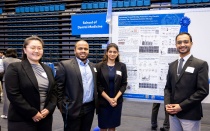
- Present results of trainees’ research in the department's seminar series, SDM Research Day, Summer Oral Biology Research Day, as well as local, national and international scientific meetings.
- Publish at least two first-author manuscripts in high-impact peer-reviewed journals.
- Submit a research grant proposal based on the results of the trainees’ work.
- Write and successfully defend a PhD thesis containing at least two first-author publications (PhD trainees).
Goal 4: Fulfill benchmarks of personal and professional scientific development.
- Trainee progress will be monitored and assessed every six months for benchmarks by their Thesis Committee, which will consist of at least three full-time oral biology faculty members and one faculty member outside the Department with complementary research backgrounds
- Trainees and their mentor will submit a written report biannually that summarizes their progress and accomplishments of the past six months, as well as their goals for the next six months.
Goal 5: Apply ethical principles to all aspects of their professional life.
- Trainees will successfully complete a Research Ethics course.
- Trainee evaluation committees will assess and report on ethical aspects of professional development.
Goal 6: Apply ethical principles to all aspects of their professional life.
- Trainees will participate in teaching and tutoring activities within the Department of Oral Biology and/or the School of Dental Medicine.
- Senior trainees will participate in the evaluation and development of junior trainees through hands-on laboratory techniques or in preliminary examinations.